
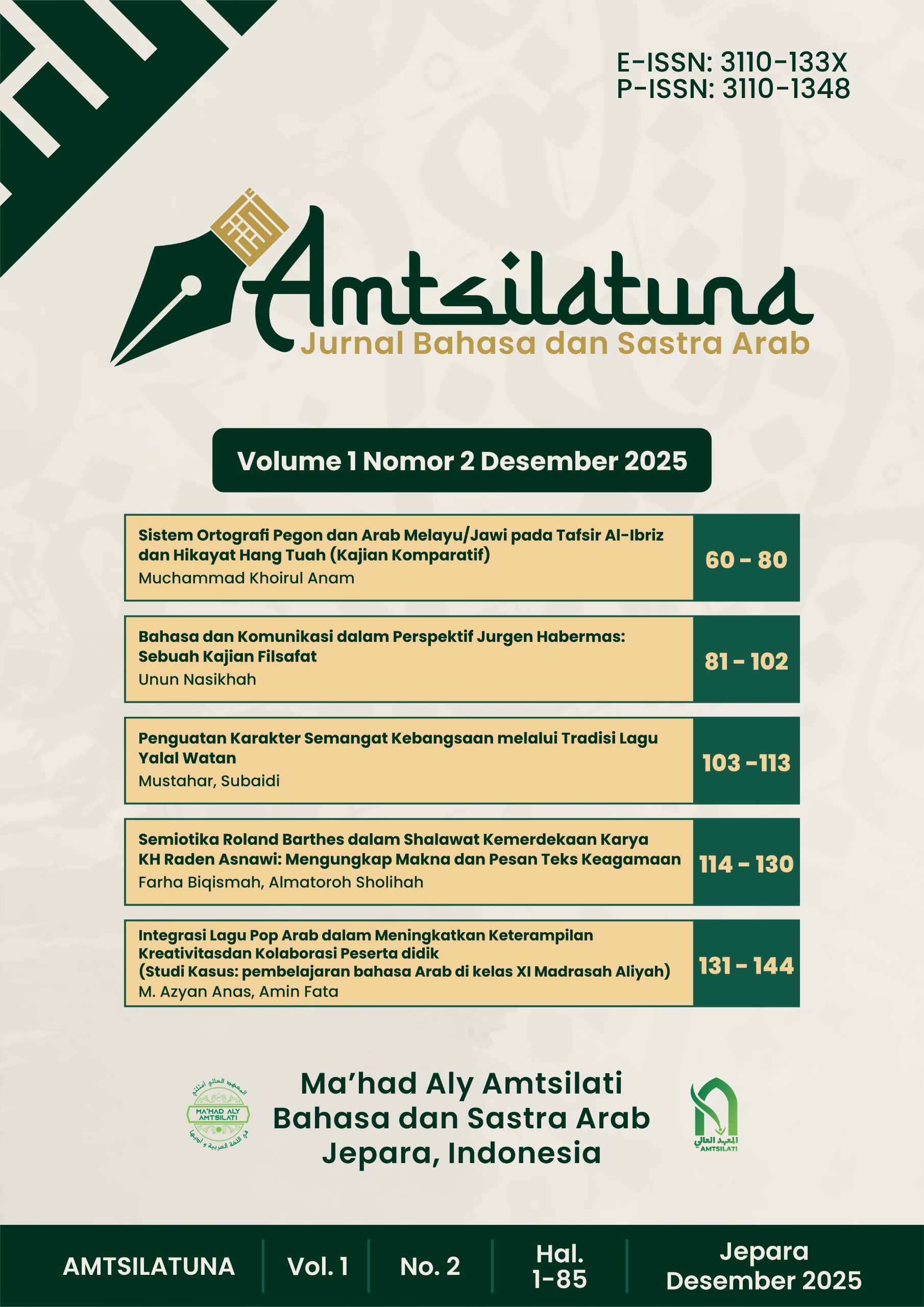
Bahasa Dan Komunikasi Dalam Perspektif Jurgen Habermas: Sebuah Kajian Filsafat
DOI:
https://doi.org/10.65526/3wxds940Keywords:
Communication, Jurgen Habermas, Language, PhilosophyAbstract
The study of the philosophy of language is increasingly relevant in the digital era, where there is a deadlock in subject-object communication that requires an intersubjective approach. This study aims to describe Jurgen Habermas's thoughts on the philosophy of language, including its relationship to monological and hermeneutic understanding, and analyze his concept of communication which includes the division of three worlds, four claims of validity, and four types of action. The method used is library research by reviewing the literature on Jurgen Habermas's thoughts descriptively and analytically. The results show that Habermas views language as a fundamental means to achieve reciprocal understanding (mutual understanding) in human interaction, with rationality inherent in the structure of language itself. Ideal communication is only possible in a state of mutual freedom and oriented towards rationality. Habermas divides the world into objective, social, and subjective, and identifies four claims of validity to fulfill the communicative ratio: truth (objective world), accuracy (social norms), honesty (inner self), and comprehensibility. This thought becomes the philosophical foundation for modern social interaction.
Downloads
Published
Issue
Section
License
Copyright (c) 2025 Amtsilatuna: Jurnal Bahasa dan Sastra Arab

This work is licensed under a Creative Commons Attribution-ShareAlike 4.0 International License.